Showing posts with label Arlo Guthrie. Show all posts

Arlo Guthrie [1996] Alice's Restaurant - The Massacree Revisited

[01] Alice's Restaurant (The Massacree Revisited)
[02] Chilling Of The Evening
[03] Ring-Around-a-Rosy Rag
[04] Now And Then
[05] I'm Going Home
[06] The Motorcycle Song
[07] Highway In The Wind


amg: At the outset of his second recorded performance of the anti-war shaggy-dog story-song "Alice's Restaurant," Arlo Guthrie notes that 30 years have passed since the events described in the song. That anniversary may serve as a useful touchstone for this only slightly revised retelling, but a more likely explanation for why Guthrie would re-record not only his most famous song, but also his entire first album in soundalike fashion is simply that, unlike most of his records, Alice's Restaurant is still owned by Warner Bros. Records and not by Guthrie's own Rising Son label. The new version of the title song has a few new jokes in it (it's even longer than the original), and Guthrie faithfully re-creates such songs as "Ring-Around-A-Rosy Rag" and "The Motorcycle Song," but the original album is still the one to own.
(amg 8/10)

Arlo Guthrie [1977] The Best Of Arlo Guthrie

[01] Alice's Restaurant Massacree
[02] Gabriel's Mother's Highway Ballad #16 Blues
[03] Cooper's Lament
[04] Motorcycle (Significance Of The Pickle) Song
[05] Coming Into Los Angeles
[06] Last Train
[07] City Of New Orleans
[08] Darkest Hour
[09] Last To Leave


amg: Had he not done anything else of significance, Arlo Guthrie could have built his entire career on the 18-minute folk/protest/novelty piece "Alice's Restaurant Massacree." And while early on it seemed as if this sort of humorous, hippie storytelling would be his metier, "Woody's son" slowly began to develop into a serious artist in his own right. Released in 1977, The Best of Arlo Guthrie is a worthwhile collection, if only for rescuing cuts like "Alice's Restaurant" and the live "Motorcycle (Significance of the Pickle) Song," and placing them in better company than some of his '60s records provided. Whereas these tunes — including the smuggler's tale, "Coming into Los Angeles" — were the highlights of his early recordings, they would simply act as pleasant distractions as his career progressed. As the '70s rolled around, such fine albums as Hobo's Lullaby — which featured his lone Top 40 hit, Steve Goodman's "City of New Orleans" — and Last of the Brooklyn Cowboys showed real maturity, but were still most notable for Guthrie's taste in, and interpretations of, other folks' songs. Still, the latter's self-penned "Last Train" is among the best moments here. The track, which is built around Ry Cooder's soulful, acoustic guitar accompaniment, improves on such previous Guthrie originals as "Gabriel's Mother's Hiway Ballad #16 Blues" (also included here), and leads into what would be his most productive period as a songwriter. "Last to Leave" and "Darkest Hour," taken from his eponymous 1974 release and 1976's Amigo, respectively, are good examples of this growth. The Best Of is a decent introduction to Arlo Guthrie's first ten years, but also look to the aforementioned records, starting with his best, Amigo, to get a more extensive overview of his music.
(amg 8/10)

Arlo Guthrie [1973] Last Of The Brooklyn Cowboys

[01] Farrell O'Gara
[02] Gypsy Davy
[03] This Troubled Mind Of Mine
[04] Week On The Rag
[05] Miss The Mississippi And You
[06] Lovesick Blues
[07] Uncle Jeff
[08] Gates of Eden
[09] Last Train
[10] Cowboy Song
[11] Sailor's Bonnett
[12] Cooper's Lament
[13] Ramblin' 'Round


amg: In the midst of the singer/songwriter era, Arlo Guthrie chose to become his generation's true folk singer, closer in spirit to Pete Seeger than to James Taylor, more an interpreter than a prolific songwriter. In this role, he kept songs alive that may have been forgotten or were never known, and recorded songs from the pens of his contemporary peers. Last of the Brooklyn Cowboys follows a formula similar to its predecessor, Hobo's Lullaby, with one exception — there is no hit single à la "City of New Orleans." However, this release has some very strong material woven into its mix. Guthrie gives his father's "Gypsy Davy" a bouncy Caribbean feel, breathing new life into this tale of wanderlust in a way probably not envisioned by Woody Guthrie. He also pays tribute to Hank Williams with a yodeling rendition of "Lovesick Blues," and delivers his customary Dylan song. This time it's "Gates of Eden," featuring the fingerpicked electric guitars of Clarence White and the bottleneck slide of Ry Cooder. The album also contains two of Guthrie's finest original songs, "Last Train" and "Cooper's Lament."
(amg 8/10)

Arlo Guthrie [1968] Arlo

[01] The Motorcycle Song
[02] Wouldn't You Believe It
[03] Try Me One More Time
[04] John Looked Down
[05] Meditation (Wave Upon Wave)
[06] Standing At The Threshold
[07] The Pause of Mr. Claus


amg: Arlo Guthrie was still prone to long story-songs and occasional humorous introductory monologues on his second outing. Three of the seven tracks last for longer than five minutes, though none remotely approach "Alice's Restaurant" in epic length. Recorded live at the Bitter End, it shows Guthrie starting to adapt more wholeheartedly to folk-rock instrumentation, with a full if subdued band including drums and keyboards. The songs are nothing major, and the jokes aren't as funny as they were in the late 1960s, but it's an agreeable, pleasant, intelligent album. "The Motorcycle Song" should please those looking for more comic narratives, as should "The Pause of Mr. Claus," most of which is actually a spoken monologue that does finally lead up to fairly funny punchlines. In a more purely musical vein, he touched (mildly) upon ragga-rock on "Meditation (Wave Upon Wave)," with tabla by Ed Shaughnessy. It may not have been a great record, but Arlo Guthrie was managing to establish himself as a folk-rock talent with an identity quite distinct from his famous father, not an easy feat.
(amg 6/10)

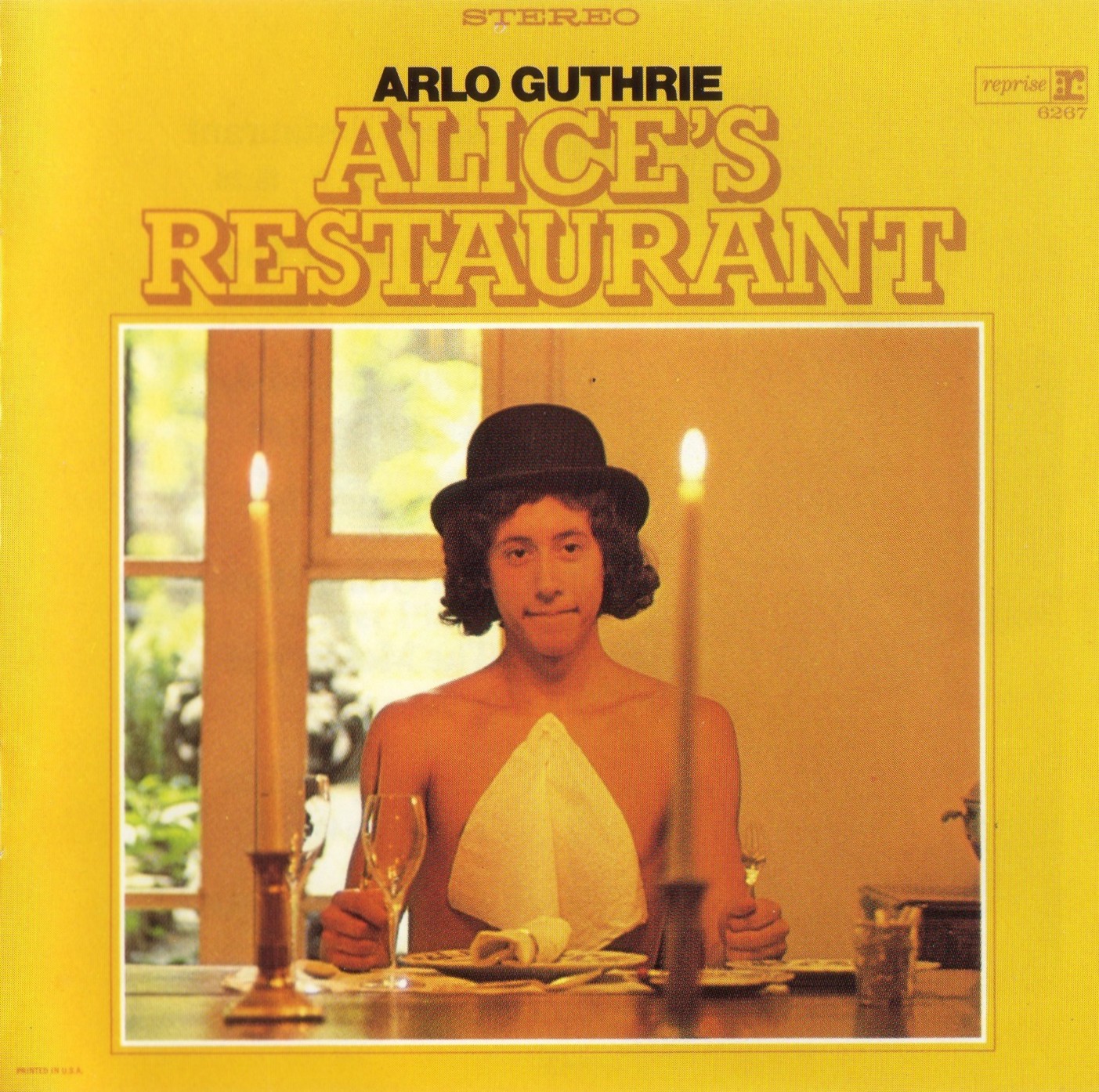
Arlo Guthrie [1967] Alice's Restaurant

[01] Alice's Restaurant Massacre
[02] Chilling Of The Evening
[03] Ring-Around-a-Rosy Rag
[04] Now And Then
[05] I'm Going Home
[06] The Motorcycle Song
[07] Highway In The Wind


amg: Although he'd been a fixture on the East Coast folk circuit for several years, Arlo Guthrie did not release this debut album until mid-1967. A majority of the attention directed at Alice's Restaurant focuses on the epic 18-plus-minute title track, which sprawled over the entire A-side of the long-player. However, it is the other half-dozen Guthrie compositions that provide an insight into his uniformly outstanding — yet astoundingly overlooked — early sides on Warner Bros.. Although arguably 100 percent factual, "Alice's Restaurant Massacree" — which was recorded in front of a live audience — is rooted in a series of real incidents. This decidedly anti-establishment saga of garbage dumps closed on Thanksgiving, good ol' Officer Obie, as well as Guthrie's experiences with the draft succeeds not only because of the unusual and outlandish situations that the hero finds himself in; it is also his underdog point of view and sardonic delivery that maximize the effect in the retelling. After decades of refusing to perform the work in concert, he trotted it back out in the late '80s, adding fresh perspectives and side stories about the consequences that the song has had, such as the uncanny role that the track played in the Watergate tape cover-up. In terms of artistic merit, the studio side is an equally endowed effort containing six decidedly more traditional folk-rock compositions. Among the standouts are the haunting "Chilling of the Evening," which is given an arrangement perhaps more aptly suited to a Jimmy Webb/Glen Campbell collaboration. There is a somewhat dated charm in "Ring-Around-a-Rosie-Rag," a sly, up-tempo, and hippie-friendly bit of jug band nostalgia. "I'm Going Home" is an underrated minor-chord masterpiece that is not only reminiscent of Roger McGuinn's "Ballad of Easy Rider," but also spotlights a more sensitive and intricate nature to Guthrie's craftsmanship. Also worth mentioning is the first installment of "Motorcycle Song" — which was updated and discussed further on the live self-titled follow-up release Arlo (1968) — notable for the extended discourse on the "significance of the pickle." None of the performances on this disc were used in for the Alice's Restaurant (1969) film. However, the soundtrack — which was issued on CD by Rykodisc in 1998 — contains a full-length studio version of the "Massacree." In 1995 Guthrie marked the 30th anniversary of the original Thanksgiving Day incident which sparked the need for a Massacree in the first place. He re-recorded this entire album to uniformly superior results. Alice's Restaurant: 30th Anniversary Edition is a fun update as well as a stirring reminder of what a national treasure Guthrie's music and lyrics really are.
(amg 8/10)